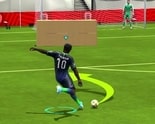
You spot a half-yard of space between the two center-backs, slip a first-time through ball into the channel, and your striker drags the shot inside the far post before the keeper can reset his feet. That sequence is why FIFA Soccer clicks with people who already watch football on weekends: the passing lanes, the pressing traps, and the payoff for a well-timed run all feel like the sport itself, compressed into a match you can finish on a lunch break.
| Genre |
Arcade football / soccer simulation |
| Match Modes |
Exhibition, Tournament, Playoffs, League |
| Core Actions |
Passing, shooting, dribbling, tackling, set pieces |
| Formation Options |
4-4-2, 4-3-3, 3-5-2, and similar tactical shapes |
| Difficulty Tiers |
Amateur through World Class-style AI levels |
| Match Length |
Two shortened halves per game |
Passing, Shooting, and Defending in FIFA Soccer
Strip away the presentation and FIFA Soccer runs on three interlocking systems. Passing moves the ball between teammates and sets the angle for your next action, shooting converts pressure into goals once you’re inside range, and defending means delaying an attacker until a second man arrives rather than diving in and gambling the tackle. A good pass sets up an easier shot, and a patient defensive shape forces a low-percentage shot instead of a clean look at goal.
Shooting rewards restraint. Timing the strike as your player’s foot connects, aiming inside the posts instead of blasting at the keeper, and choosing a finesse shot from a tight angle separate scorers from players who just take shots.
Defensively, spamming the tackle button is the fastest way to concede. Contain the dribbler, show them onto their weaker foot, and wait for support before committing.
Why Beginners Get Overrun Before Halftime
The single most common mistake new players make is treating FIFA Soccer like a button-mashing game — sprinting everywhere, forcing through balls that get intercepted, and lunging into every tackle. That works against weak AI for a few minutes and falls apart once the opponent strings together quick one-twos through the middle.
Casual players who just want a quick exhibition match before dinner often stop here, which is fine, but it caps how far a team can go once difficulty rises.
The second mistake is positional: chasing the ball with every player at once instead of holding a line. When fullbacks abandon their lane to double up, the space they leave is exactly where a good opponent plays the next pass.
- Holding possession with short passes instead of forcing long balls into traffic
- Keeping a compact defensive line rather than chasing the ball out of position
- Switching play to the weak side when the near flank gets congested
- Bringing a spare defender back instead of doubling up on one jockeying teammate
Formations and Tactics That Actually Hold Up
A common question is what formation is best in FIFA Soccer, and the honest answer is that it depends on the squad, not a single magic shape. A 4-4-2 gives two banks of four that are easy to defend and two strikers who can combine, forgiving for anyone still learning the pitch. A 3-5-2 crowds the midfield and can dominate possession against teams that only play through the center, though it exposes the back three if wing-backs get caught upfield.
Tactical players who enjoy tinkering with sliders may spend more time in the formation screen than in the match, nudging defensive width for an edge.
None of these are a shortcut around fundamentals. A 4-3-3 played without positional discipline concedes just as much as a badly organized 4-4-2 — the formation sets the shape, but you still defend it.
Climbing From Exhibition to League and Playoffs
Exhibition mode is where most people start: pick two teams, play a single match, and get a feel for the controls. Once that stops being a challenge, Tournament mode raises the stakes with a World Cup-style bracket where one bad half ends your run, and League mode demands consistency across a double round-robin schedule where fatigue and rotation matter. Playoffs mode drops you into the knockout rounds if you’d rather skip the group stage.
Against a low-difficulty opponent, the AI defense tends to sit off and invite you through, which teaches bad habits. Against a stronger opponent on a higher tier, that same sloppy passing gets picked off in midfield and punished on the counter within two or three passes.
Facing Stronger Opponents in Tournament Mode
The jump in AI behavior from the lower tiers to something closer to World Class is noticeable and, for many players, is the most divisive part of FIFA Soccer. The higher tiers press with better coordination and close down passing lanes you’d normally rely on — some call it a genuinely smart opponent, others call it unfair.
Skill Moves, Timed Finishing, and Defensive Jockeying
Once the basics are solid, the techniques that separate stronger players are mostly about timing rather than speed. Timed finishing — hitting the shot button a second time right as your player strikes the ball — adds accuracy and power beyond a standard shot, but mistiming it sends an open chance wide — a real risk, not a guaranteed upgrade. Skill moves like step-overs and the nutmeg beat a defender one-on-one and only work when there’s real space; throwing one at a well-set defender just gives the ball away.
Defensive jockeying — holding position side-on instead of standing square — lets you shepherd a dribbler away from goal without diving in, an underused tool among newer players.
The Nutmeg Window and Other Close-Control Reads
Defenders telegraph the nutmeg window with their stance. A player squared up with legs apart is a live target for a through-the-legs nutmeg; a defender turned side-on and compact usually isn’t, and trying it anyway just gets the ball poked away. Community terms like panna and meg describe exactly this moment.
- Approach the defender at an angle rather than running straight at them
- Watch their stance for an open gap between the legs
- Push the ball through only once the gap is clearly there, not on a hopeful guess
- Follow the run immediately since the ball doesn’t collect itself on the other side
Set Pieces Decide More Matches Than You Think
Corners, direct kicks, and penalties come up constantly, and a fair share of goals come from a dead ball rather than open play. Aiming a corner toward the near post for a flick-on differs from floating one to the back post for a header, and defending them means picking up runners rather than watching the ball.
Direct kicks close to the box reward a curled shot over or around the wall more often than a straight power strike into it. Penalties are a mini-game of nerve — placing the shot low into a corner and committing beats second-guessing the direction mid run-up.
Set-piece specialists — players who’d rather line up a dead-ball routine than dribble through traffic — tend to get more out of FIFA Soccer over a League campaign than anyone relying purely on open play.
What FIFA Soccer Players Keep Arguing About
Beyond the difficulty debate, another long-running argument is whether goalkeeper behavior is consistent — a keeper who parries a rocket shot straight back into danger one minute and pulls an outrageous reflex save the next can feel inconsistent rather than challenging. Some players also point out AI teammates don’t always make the run you’d want, leaving you without a passing option when one should be there. Neither complaint ruins the game, but naming them saves newer players from thinking they’re alone in noticing.
Competitive players who grind a full League season feel these inconsistencies more than someone playing a single Exhibition match, since a bad bounce costs more in a title race.
Beating a stronger opponent, rather than just surviving one, combines everything above: hold your shape, don’t force the killer pass into a crowded box, let the AI overcommit before you break at pace, and save skill moves for a stance that invites one.
FIFA Soccer rewards exactly the kind of match awareness real football rewards — patience in possession, discipline in a back four, and the nerve to place a penalty instead of blasting it — and that’s still true whether you’re closing out a scrappy 1-0 in Exhibition or chasing a late equalizer in the League table with a 4-3-3 pushed forward.